Tr

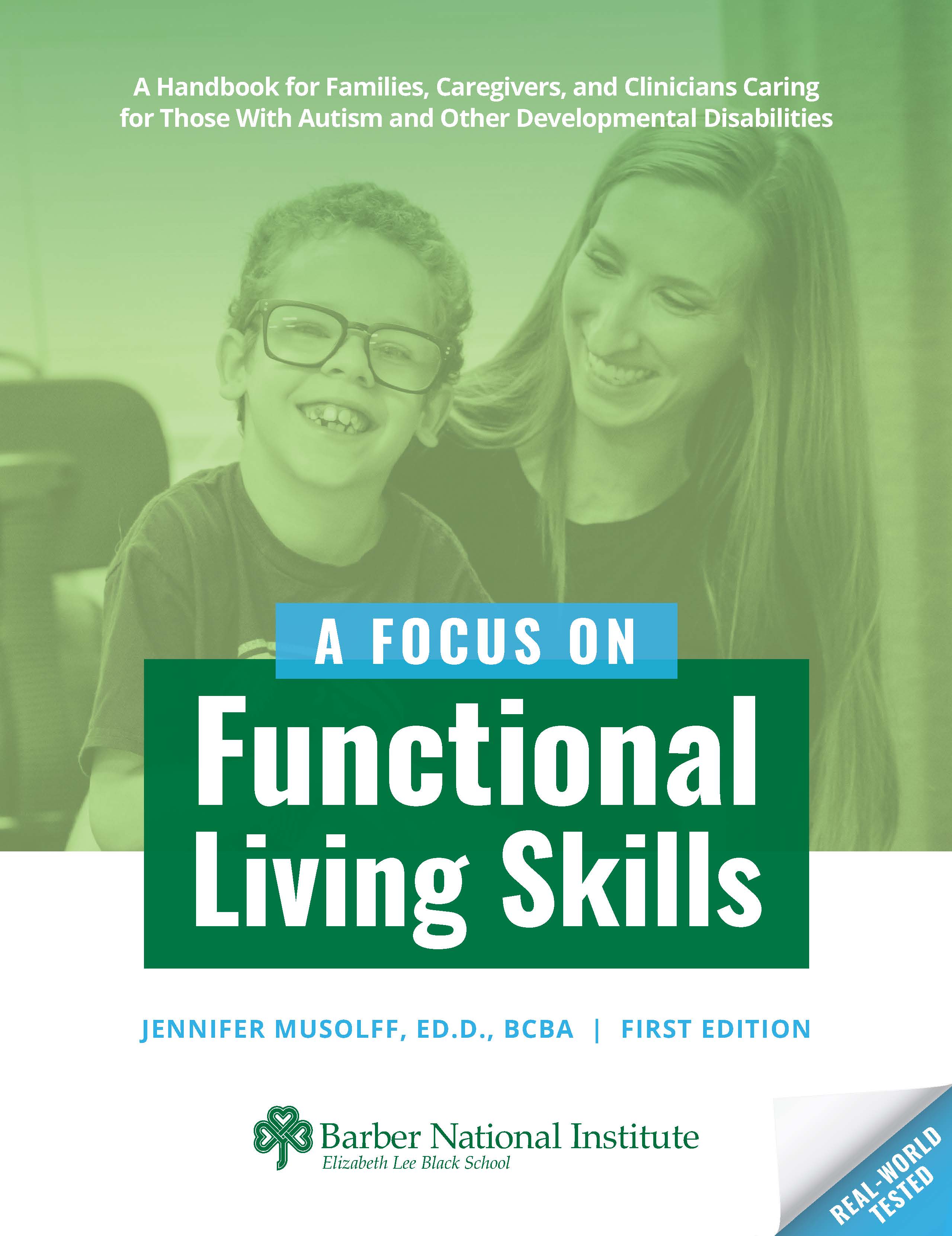
The cover for

A Focus on Functional Living Skills: A Handbook for Caregivers and Clinicians Caring for those with Autism or Developmental Disabilities 

By Jennifer Musolff, Ed.D, BCBA


Teaching functional living skills to individuals with autism and other developmental disabilities can feel overwhelming, especially when endless advice, programs, and methods pull you in different directions. A Focus on Functional Living Skills: A Handbook for Families, Caregivers, and Clinicians Caring for Those With Autism and Other Developmental Disabilities cuts through the noise with a clear, practical, and time-tested approach developed by Barber National Institute, a nationally recognized leader in supporting individuals with special needs. 

This indispensable handbook equips families, caregivers, educators, and clinicians with the tools needed to confidently build independence at home, at school, and in the community. Grounded in real-world experience and decades of applied practice, it delivers step-by-step strategies that work. 

Add To Cart

Inside, you’ll discover how to: 

  1. Understand the foundations of functional living skills and why they matter for long-term success.
  2. Navigate key terminology and concepts used when teaching and assessing daily living abilities.
  3. Follow a logical progression of skill development, helping you know exactly where to start and how to advance.
  4. Use task analysis effectively, including how to break down skills, write clear steps, andteachwith confidence. 

Whether you’re new to this work or looking to refine your approach, this handbook offers a trusted roadmap backed by clinical expertise and real-life results. Let Barber National Institute guide you in making meaningful, measurable progress, one attainable skill at a time. 

  • Price: $19.99 + shipping & handling
  • PA tax applicable for PA residents & purchases in PA
  • PA residents & purchases made in PA are subject to the prevailing PA Sales Tax Requirements.
  • By ordering this handbook you agree to our terms & conditions.

Call Barber National Institute with questions at (814) 878-4087 or debranuhfer@barberni.org

Testimonials

As parents of a non-verbal autistic child, our child’s path has been turbulent at times. Dr. Musloff’s handbook gives incredible examples of how to reinforce positive behaviors within our child’s day. These techniques are critical to helping him live as independently as possible. We believe that every parent with a child with developmental delays would find this handbook helpful in teaching daily living skills.


Nick and Amanda H.

Meet the Author Excerpt - Indtroduction Excerpt - How to Teach Skills Terms & Conditions Shipping Policy

Meet the Author

Musollf

Jennifer Musolff, Ed.D., BCBA, has extensive experience in the field of Applied Behavior Analysis supporting children with autism during a career that spans more than twenty years.

In her current role as a board-certified behavior analyst at Barber National Institute’s Elizabeth Lee Black School in Erie, PA, she develops and implements behavior intervention plans for students ages 3 – 21 with autism, intellectual disabilities or behavioral health challenges. She also provides training and consultation to professionals working in the field, and works with families on implementing behavior plans and strategies to benefit their children.

During her career, Dr. Musolff has held a number of positions including program supervisor for the acute partial hospitalization program at the Barber National Institute for students with challenging behavior health issues, and as a clinical supervisor in the Intensive Behavior Health Services.

Dr. Musolff also serves as an adjunct faculty in the Applied Behavior Analysis Program at Mercyhurst University, where she earned a master’s degree in special education. She was awarded a Doctor of Education from Youngstown State University.

Dr. Musolff is recognized for her dedication and finding rewards in the impact that she and her staff have on the lives of children, whether it is hearing a child with autism say his first word, make eye contact for the first time or tolerate everyday activities such as brushing his teeth. Even after challenging days, it is what moves her to “give her all” to her students. She is also the author of Effective Instruction for Children with Autism: An Applied Behavior Analytic Approach.

Chapter 2 - Introduction

When trying to find information on how best to teach functional living skills to individuals with special needs, you will find a plethora of various resources on the topic. Although access to an abundance of information on any topic can be helpful, it can quickly become very overwhelming, especially when you don’t know where to start.

A Focus on Functional Living Skills: A Handbook for Families, Caregivers, and Clinicians Caring for Those With Autism and Other Developmental Disabilities offers clear, practical guidance to help caregivers and clinicians support individuals with autism spectrum disorder (ASD) and developmental disabilities in building independence and preparing for adulthood.

The goals of this handbook are to:

  1. Provide a background and understanding of functional living skills.
  2. Review commonly used terminology when exploring this topic.
  3. Suggest a progression of skills when starting to teach functional living skills
  4. Explain the task analysis including what it is, how to write a task analysis, and how to best teach the skill

What Are Functional Living Skills?

Functional living skills, also known as activities of daily living or adaptive behavior, are essential tasks for leading an independent and meaningful life. While many children learn these skills through observation and imitation, individuals with special needs often require targeted, intensive instruction to develop them and achieve independence.

Who Should Teach Functional Living Skills?

Functional living skills, such as eating, toileting, dressing, and hygiene, are essential for independence and quality of life. While families are often the first to address these needs, individuals with special needs may require more intensive and specialized instruction than caregivers alone can provide. A collaborative approach involving trained professionals ensures that these skills are taught effectively and consistently.

Roles of Key Professionals

Behavior Analysts

  • Use Applied Behavior Analysis (ABA) to teach and reinforce daily living skills.
  • Conduct assessments to identify individual needs.
  • Develop and monitor personalized intervention plans.
  • Train caregivers and staff to implement strategies consistently

Occupational Therapists (OTs)

  • Support development of fine motor, sensory, and cognitive skills.
  • Address challenges in dressing, grooming, feeding, and toileting.
  • Modify environments and tools to promote independence.

Speech-Language Pathologists (SLPs)

  • Enhance communication related to daily routines.
  • Address oral motor skills for safe and effective eating.
  • Support social and functional communication during daily tasks.

Special Education Teachers

  • Integrate functional skills into academic and life skills curricula.
  • Use structured teaching methods, visual supports, and task analyses.
  • Collaborate with families and therapists to reinforce skills across settings.

Caregivers and Family Members

  • Reinforce skills in natural environments.
  • Provide consistency across home and community settings.
  • Advocate for services and collaborate with professionals.

Where Do I Begin?

Supporting independence can feel overwhelming at first. Common questions include: When should I start teaching these skills? Which skills come first? How do I teach complex tasks?

This handbook is designed to answer the what, when, and how of teaching essential life skills to individuals with special needs. It offers clear, easy-to-follow steps that anyone can use — even when teaching complex skills — to help foster greater independence.

What Is Discussed in This Handbook?

In this handbook, you will find the following information that will help you as you begin the important journey of increasing an individual’s independence in life.

  • A review of key terms used throughout the manual. Take a moment to familiarize yourself with them — they will help you better understand the procedures.
  • The importance of teaching functional living skills.
  • A review of the progression of when we learn these skills, and what to focus on and teach first.
  • A how-to guide on teaching functional living skills. The procedures are laid out one step at a time and take you through a sequential series of steps to meet the end goal.
  • A list of resources for you to learn more about functional living skills.
  • Appendices of specific task analyses for common functional living skills.

How to Teach Skills

Once you’ve identified which skills to teach, the next step is choosing how to teach them. It is often helpful to break the skill down into smaller, manageable steps, creating a task analysis. A task analysis outlines a sequence of steps that, when taught individually, lead to the successful completion of the skill.

Some task analyses are brief and highlight only key actions, while others are more detailed, depending on the learner’s skill level and needs.

Let’s look at an example of two different task analyses on washing hands:

WASHING HANDS #1

  1. Walk to sink.
  2. Get soap.
  3. Turn on the water.
  4. Rub hands together.
  5. Rinse soap from hands.
  6. Turn water off.
  7. Get a paper towel.
  8. Dry hands.

WASHING HANDS #2

  1. Walk to sink.
  2. Place right hand under nozzle of soap.
  3. With left hand, press down on nozzle.
  4. With left hand, pull the cold-water handle toward you.
  5. Rub the palms of hands together.
  6. Place right hand on top of left hand, rub.
  7. Place left hand on top of right hand, rub.
  8. Rinse soap from hands.
  9. Push the cold-water handle away from you to turn water off.
  10. Pick up hand towel.
  11. Dry the tops of hands.
  12. Dry the palms of hands.
  13. Put towel on rack.

The task analysis “Washing Hands #1” is appropriate for individuals who can perform many steps but need help with parts of the process. “Washing Hands #2” is more detailed and better for those who require support with each individual step.

To write a task analysis, imagine yourself performing the skill in slow motion. Ask: “What do I do first?” “Then what?” Continue step by step, writing down each part of the process. I often include detailed steps so that already mastered ones can be skipped, making the task analysis flexible and tailored to the learner’s needs.

To throw another complication into the process, there is often more than one way to perform a skill. Consider putting on a T-shirt. I once asked five different colleagues how they put on a T-shirt, and I received five different ways of completing this task!

When trying to determine how to write the task analysis, consider the following to help guide you:

  1. Does the individual have any mobility concerns?
  2. Is the individual left-handed or right-handed?
  3. Are there deficits with fine motor skills?

Consider This Scenario

When I wake up in the morning, the first thing I do is brush my teeth. I walk into the bathroom and open the medicine cabinet. I find my toothbrush and toothpaste, and I close the medicine cabinet door. I take the cap off the toothpaste and squeeze a small amount on my toothbrush. I put the toothpaste down and turn on the water. I wet my toothbrush and begin brushing my teeth, first the bottom teeth, then my top teeth. When I am finished, I spit in the sink, rinse off my toothbrush, and put everything back into the medicine cabinet. I wipe my mouth with a hand towel and turn off the light.

This is a basic process that is probably close to how you might brush your teeth too. Now consider this scenario in a task analysis format, keeping in mind that many of the steps can be broken down even more, if needed.

  1. Walk into the bathroom.
  2. Open the medicine cabinet door.
  3. Get toothbrush.
  4. Get toothpaste.
  5. Take cap off toothpaste.
  6. Hold the toothbrush in your left hand.
  7. Hold the toothpaste in your right hand.
  8. Squeeze a small amount of toothpaste on the toothbrush.
  9. Turn water on.
  10. Wet toothbrush.
  11. Place toothbrush into mouth.
  12. Brush teeth.
    • 12a. Brush the front bottom teeth.
    • 12b. Brush the back bottom teeth.
    • 12c. Brush the front top teeth.
    • 12d. Brush the back top teeth.
  13. Spit.
  14. Rinse off toothbrush.
  15. Put toothbrush away.
  16. Put cap on toothpaste.
  17. Put toothpaste away.
  18. Wipe mouth.
  19. Turn off the light.

Once you have finished writing the task analysis, it may be helpful to read each step and have someone perform the steps as you read them. This way, you can “watch” what you wrote and highlight anything that needs to be added or changed.

Terms & Conditions

Disclaimer

This publication is not being sold for the purpose of rendering medical, clinical, therapeutic, or other professional advice or services. The information contained in this publication is provided for general informational and educational purposes only and may or may not reflect current instructional developments regarding Autism Spectrum Disorders. The information in this publication is subject to change at any time without notice and should not be relied upon as a substitute for individualized professional judgment or advice, including professional medical or healthcare advice. Neither Dr. Gertrude A. Barber Educational Institute, Inc., nor any of its affiliated or related entities, as publisher or distributor, makes any representations, guarantees, or warranties, express or implied, concerning the information in this publication. If medical advice or other professional assistance is required, the services of a qualified professional should be sought.

Return Policy

We want you to be completely satisfied with your purchase. Therefore, we offer you a 10-day examination period for the book.

Opened books must be returned within 10 business days of the invoice date: you may return the book for a full refund, less the shipping and handling costs. Please note unopened and original shrink-wrapped books can be returned up to 90-days of the invoice date.

Just follow these easy steps to return:

  • A return request is required by emailing DebraNuhfer@barberni.org.
  • We cannot refund returns of the book if it is marked or damaged.
  • Include a copy of the original invoice (or the invoice number and invoice date) with the returned book so that we can issue the proper refund.
  • To guarantee delivery of your return, please purchase a delivery confirmation for your package.

Returns must be sent postpaid to:
Barber National Institute
Attn: Ed Institute
100 Barber Place
Erie, PA 16507

Shipping Policy

The Barber National Institute will ship anywhere in the world; however we only accept online payments for US orders. If you are located outside of the United States please call (814) 878-4087 to place your order.

You will be notified when your order has been shipped. Your credit card will be charged at the time of shipment and all orders will be shipped via USPS.

If you have any questions or need to report a defective book please call (814) 878-4087 or email DebraNuhfer@barberni.org

Celebrate What's Different: Why do certain words make a comeback, and why does it matter?
Celebrate What's Different: Back to School, Your Way
Celebrate What's Different: Project Search Vocational Program