Why the "R" Word Still Hurts and Why We Must Do Better
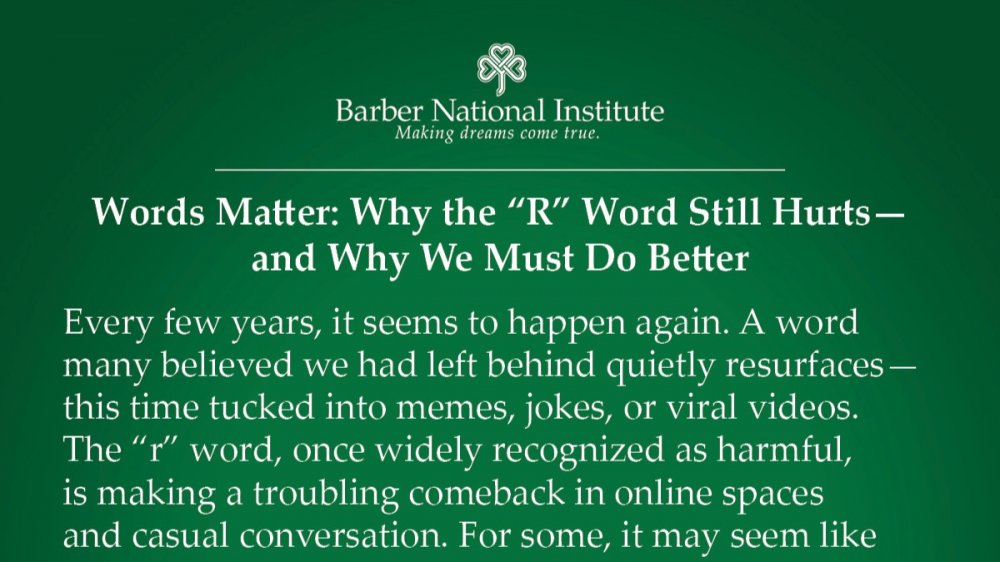
Erie, PA (February 18, 2026) - Every few years, it seems to happen again. A word many believed we had left behind quietly resurfaces—this time tucked into memes, jokes, or viral videos. The “r” word, once widely recognized as harmful, is making a troubling comeback in online spaces and casual conversation.
For some, it may seem like harmless slang or “just a joke.” For families, advocates, and individuals with intellectual disabilities, it is a painful reminder that dignity and respect are still fragile.
Language is not neutral. The words we choose reflect our values and shape how we treat one another. When harmful language is repeated casually, it reinforces stigma—whether that harm is intended or not.
The “r” word did not begin as a slur. In the early 20th century, it was introduced as a clinical term to describe developmental delays. It replaced the older medical labels such as “idiot”, “imbecile”, and “moron”, which were once formal diagnostic categories. But words evolve, and this one took a cruel turn. Over time, it migrated from medical charts to playground taunts and public ridicule, becoming a shorthand insult used to demean, exclude, and dehumanize. By the late 20th century, its meaning was no longer clinical—it was overwhelmingly derogatory.
I was a special education teacher in a high school program when I first heard the students in my class referred to as “retards.” I was shocked. I then understood why my students did not want anyone to know that they attended my class.
For this reason, I joined with advocates and families and fought for change. In 2010, the federal government formally replaced “mental retardation” with “intellectual disability,” recognizing that language should reflect respect, not reduction. This shift was more than semantic. It was an acknowledgment that people are more than labels—and that words can either affirm humanity or strip it away.
Yet today, despite this progress, the word is resurfacing—often driven by social media trends that reward shock value over empathy. Online platforms make it easy for harmful language to spread quickly, divorced from context or consequence. A joke posted for laughs can reach millions, normalizing language that many worked decades to retire.
For families of individuals with intellectual disabilities, this resurgence cuts deep. It signals to children and adults alike that their worth is still up for debate. And it undermines years of advocacy aimed at building inclusive schools, workplaces, and communities.
The harm is not abstract. Casual slurs affect mental health, self‑esteem, and belonging. They influence how peers treat one another, how professionals view the people they serve, and how society decides who deserves support and understanding. When we excuse harmful language as humor, we ignore its cumulative impact—and the message it sends about whose feelings matter.
This is not about policing speech. It is about accountability and awareness. Just as our understanding of disability has evolved, so must our language. We already know better. We have better words. Choosing to use them is a matter of respect.
Each of us plays a role in shifting the culture. That starts with pausing before repeating a trending phrase, questioning why a joke relies on putting someone else down, and being willing to speak up—even when it feels uncomfortable. It means listening to people with disabilities and their families when they tell us what hurts and what helps.
Words can wound, but they can also heal. When we choose language rooted in dignity, we affirm that everyone belongs. The “r” word is not just outdated—it is unnecessary. And leaving it behind, for good, is a simple but powerful step toward a more inclusive community.
Because words matter. And so do the people they affect.
To learn more about this topic, stream Barber National Institute’s podcast Celebrate What’s Different.
Dr. Maureen Barber-Carey is executive vice president at Barber National Institute. She is also the author of a monthly blog, All About Autism